
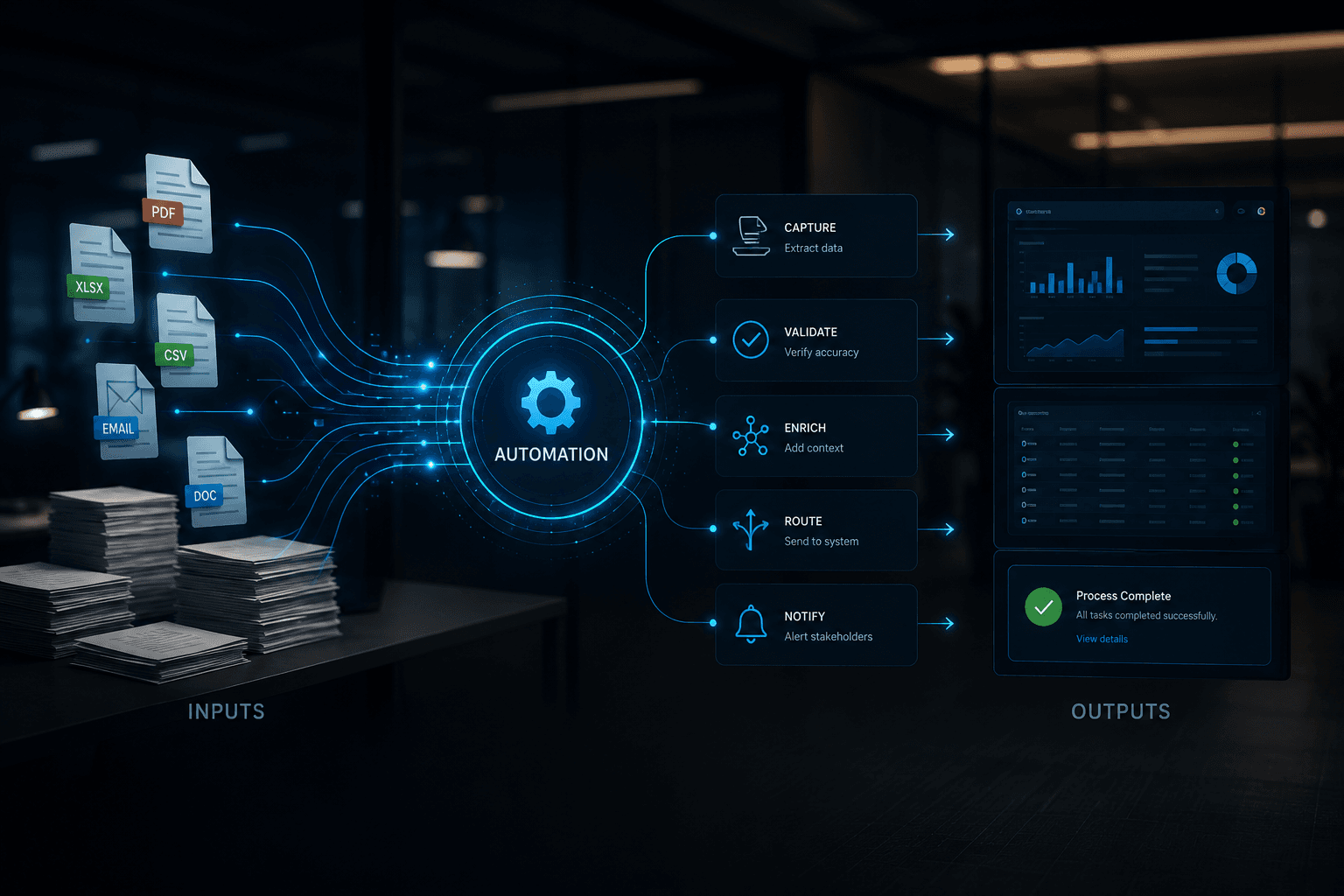
When people talk about "AI agents," they often mean very different things. A chatbot that follows a script gets called an agent. So does an autonomous system that can ingest a contract, compare it to regulatory requirements, flag compliance issues, draft a summary memo, and route it to the right stakeholder without a human managing each step.
Those aren't the same thing. The second one is what we mean when we talk about agentic workflows. Building them well requires understanding their architecture.
The Four Layers
### 1. Perception: What the Agent Knows About the World
Perception is how an agentic system receives inputs. This includes text inputs like emails, documents, tickets, and form submissions; structured data like database records and API responses; and triggers like scheduled events, file arrivals, and webhook calls.
Most production agentic workflows have multiple perception channels. A document processing agent might watch an email inbox, a file upload portal, and an API endpoint simultaneously, ingesting and normalizing inputs from each before passing them to the reasoning layer.
Gaps in perception design mean missed triggers or malformed inputs that the downstream system can't handle gracefully.
### 2. Memory: What the Agent Remembers
Memory in agentic systems exists at two levels.
Short-term memory is the agent's working context: the current conversation, the document being processed, the retrieved information relevant to the current task. Modern LLMs support context windows of 128,000 to 200,000 tokens, which is enough for most single-task interactions.
Long-term memory is where the agent accesses organizational knowledge that doesn't fit in a single context window: the full document library, historical records, previous decisions, accumulated operational data. Retrieval-augmented generation is how long-term memory gets surfaced. The agent queries a vector database to retrieve relevant chunks and injects them into its working context.
Getting the memory architecture right is one of the most important design decisions in an agentic system. Too little context and the agent makes decisions without enough information. Too much and performance degrades and costs escalate.
### 3. Reasoning: What the Agent Decides to Do
The reasoning layer is the LLM, the brain of the system. Given its perception inputs and available memory, it decides what to do next: breaking a complex goal into steps, selecting which tools or APIs to call, judging when a decision is within scope for autonomous action versus when to escalate, and working through multi-step problems by generating intermediate reasoning steps before producing a final output.
Modern reasoning models are specifically optimized to spend more time on this deliberation step, which improves accuracy on complex tasks significantly.
### 4. Action: What the Agent Does
The action layer is where decisions translate into real-world effects.
Tool calls mean querying a database, calling an external API, running a calculation, or searching for information. System integrations mean writing to a CRM, updating a ticket, sending a notification, or creating a document in a content management system. Communication means drafting emails, posting updates to Slack, or generating reports. Human handoff means routing a decision to a reviewer with context, flagging a case for escalation, or requesting approval before proceeding.
The integration depth of the action layer is what separates a demo from a production system. An agent that can reason and plan but can't write its conclusions to the systems where work happens doesn't close the loop.
The Loop
What makes an agentic system agentic, rather than just a complex LLM call, is the loop. After taking an action, the agent observes the result and updates its understanding of the current state. Did the API call succeed? Did the document pass validation? Did the human approve the recommendation? That observation feeds back into the next reasoning cycle.
Designing this loop carefully, including what happens when actions fail, when results are ambiguous, and when the agent has exhausted its options, is where production systems are built or broken.
Human Oversight: A Design Decision, Not an Afterthought
Every agentic workflow we build has explicit human oversight points. These aren't compensations for a system we don't trust. They're principled design choices about where human judgment is genuinely necessary.
Low-confidence outputs are routed for human review. High-stakes actions require explicit approval. Edge cases that fall outside the agent's scope are escalated rather than guessed at.
The best agentic workflows don't eliminate humans from the process. They eliminate humans from the parts that don't benefit from human involvement, and route everything else to the right person, with the right context, at the right moment.