
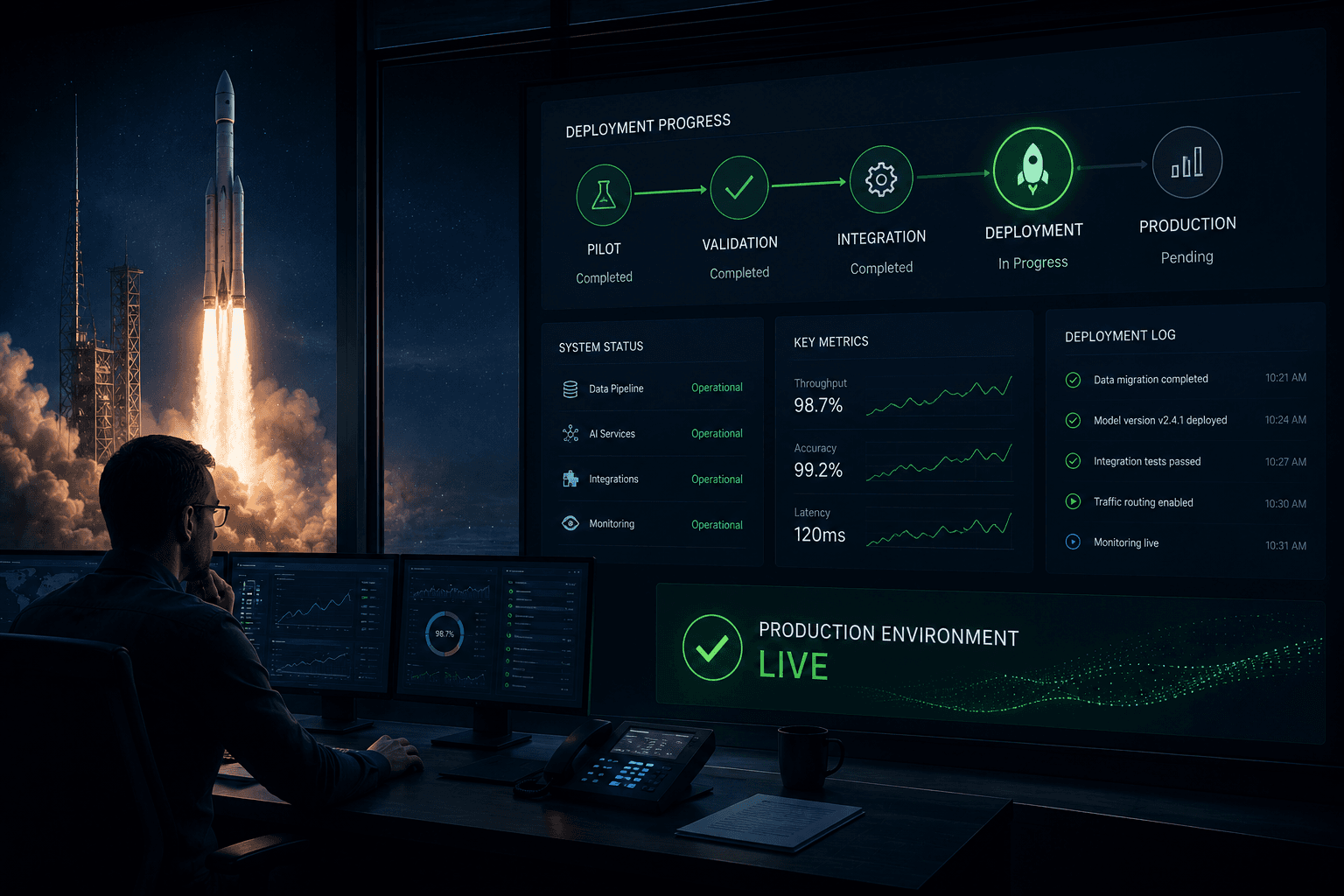
After working through AI engagements across industries, one pattern is consistent: the technology rarely fails first. What fails is the process around it. Ambiguous scope. Poor integration planning. Systems built for demos that can't survive production conditions. An AI model that works in isolation but has no clear path into the workflow it was supposed to improve.
The TTG Operational AI Delivery Framework is our response to that pattern. It is the structure we apply to every engagement, regardless of industry or use case. It keeps scope clear, builds in the decisions that determine whether systems actually work, and gives clients a production-ready system rather than a promising prototype.
The Framework in Brief
The framework operates across three phases: Pilot, Build, and Grow. Each has a distinct purpose and defined deliverables. Together, they move an engagement from discovery to a production system that operates reliably at scale.
Within these phases, every engagement moves through four stages: Discover, Design, Build, and Deploy and Scale. The stages are sequential. Each one depends on the output of the previous one.
Stage 1: Discover
This is the stage most implementations skip or rush. It is also the stage that determines whether the final system will have real operational value.
Discovery means mapping the actual workflow, not the idealized version. Where does data come from? What systems are involved? Where does work get handed off between people, and where do handoffs break down? What decisions happen inside the workflow that require judgment, and what decisions are essentially mechanical? Where is time being spent that a well-designed system could recover?
The output of Discovery is a workflow map, a data inventory, and a set of success metrics defined in business terms: not model benchmarks, not accuracy percentages, but what the system needs to do to be worth deploying.
We also use this stage to identify the scope of the pilot. The best AI pilots are narrow and real, not broad and synthetic. A narrow pilot on actual operational data surfaces integration complexity early, when it is cheap to address. A broad pilot on mocked data produces a demo that falls apart the moment it touches production systems.
Stage 2: Design
Design is where the critical architectural decisions get made. Which models, and why. What retrieval strategy. How the system integrates with existing infrastructure. Where the human oversight points are, what triggers them, and who owns them. How the system will be monitored once it is live.
These decisions have long-term consequences. Bad architecture decisions made in Design are expensive to undo in Build and nearly impossible to correct in production. We spend more time here than most.
The output of Design is an architecture specification that covers the full system: data flow, integration points, model orchestration, oversight design, and monitoring plan. No code is written until this document is agreed on.
Stage 3: Build
Build is structured in two sub-phases.
The first is the Pilot Build. We build the smallest version of the system that demonstrates real value on real data. The pilot runs against actual operational inputs, integrates with actual systems, and is evaluated against the success metrics defined in Discovery. It is not a demo. It is a functioning system with defined scope.
Pilot scope is typically one workflow or one document type. The goal is to prove the approach, surface integration and data quality issues before the full build, and give the client concrete evidence of what the system can do in their actual environment.
If the pilot succeeds, we move to Production Build. This phase extends the system to full scope: all planned workflow coverage, complete integration with production systems, error handling, confidence scoring, escalation logic, logging, and observability. The system is load-tested, security-reviewed, and documented before it is deployed.
Stage 4: Deploy and Scale
Deployment is not the end of the engagement. It is the beginning of the phase that determines whether the system delivers sustained operational value.
We deploy with a defined monitoring plan. Success metrics are tracked and reviewed. We document what good performance looks like, what anomalies to watch for, and what the response process is when something behaves unexpectedly.
The Grow phase that follows focuses on expanding what the system does, based on what the production data shows. Workflows that were descoped from the pilot can be added. New document types can be ingested. The knowledge store can be extended. The goal is a system that improves over time as operational data accumulates, not one that is deployed and forgotten.
Why the Three Phases Matter
Pilot, Build, and Grow map to how organizations actually absorb change.
The Pilot phase answers the question: does this work for us? It produces a functioning system, not a slideshow. Stakeholders can see the output. Operators can interact with it. The evidence is operational, not theoretical.
The Build phase answers the question: can we run this in production? It takes everything the pilot proved and extends it to full coverage, with the reliability and oversight that production requires.
The Grow phase answers the question: how do we get more from what we built? It treats the initial deployment as a foundation rather than a finish line.
What the Framework Produces
Every engagement that runs the full framework delivers four things: a production-ready system, a documented architecture that the client's team can understand and maintain, an operational monitoring plan with defined success metrics, and a clear roadmap for what comes next.
The framework is not a guarantee that every AI system will work. AI systems succeed or fail based on data quality, integration depth, organizational commitment, and a dozen other factors that vary by client. What the framework guarantees is that those factors are identified early, planned for deliberately, and not discovered after deployment.
That is a meaningful difference.