
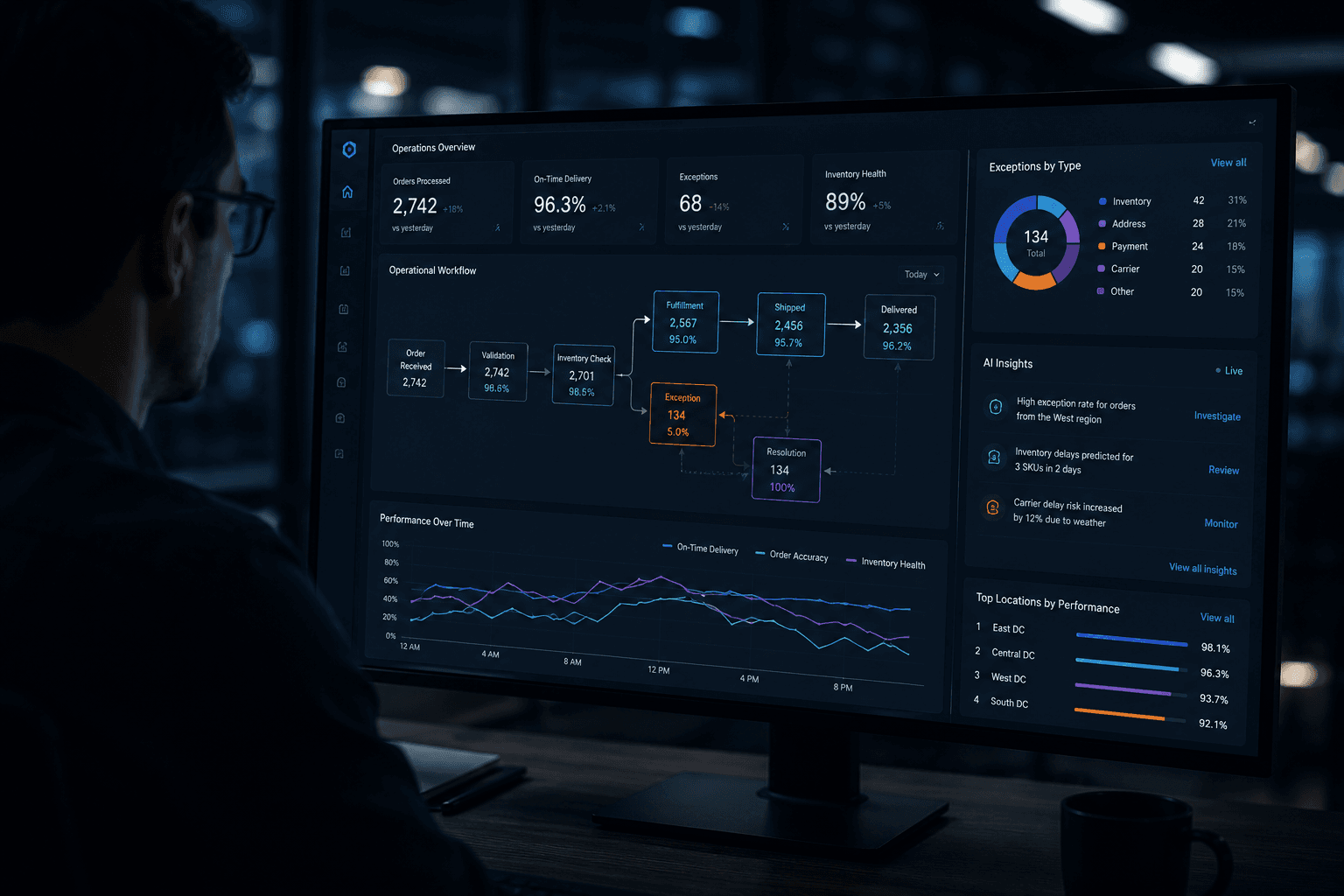
There's a tendency in enterprise AI discussions to use "generative AI" and "agentic AI" interchangeably. They're not the same thing, and the distinction carries real implications for how you architect, deploy, and govern AI systems inside your organization.
Generative AI: Powerful, But Reactive
Generative AI, the category that includes large language models like GPT-4, Claude, and Gemini, is fundamentally reactive. It receives an input, processes it, and produces an output: text, code, a summary, an image. The model doesn't set goals, make plans, or take action in the world. It waits for a prompt, responds, and stops.
This is enormously useful. Generative AI has already transformed content creation, code assistance, document summarization, customer communication, and internal knowledge retrieval. For tasks where a human provides the prompt and reviews the output, it delivers immediate, measurable value.
But reactive systems have a ceiling. Every step in a multi-step workflow still requires a human to close the loop.
Agentic AI: Autonomous, Goal-Directed Action
Agentic AI systems don't just respond. They act. Given a goal, an agentic system can break it into sub-tasks, determine what tools or information it needs, retrieve or call those resources, execute actions across connected systems, evaluate the results, and adjust its approach, with minimal human prompting for each step.
MIT researchers studying organizational AI transformation describe an AI agent as essentially a workflow with tasks potentially involving humans, where the AI manages the sequencing and execution rather than a human doing it manually.
The practical implications are significant. An agentic system can receive a new vendor contract, extract key terms, compare them against your standard agreement, flag deviations, and route the flagged items to the right legal contact without anyone orchestrating each step. Or it can monitor incoming support tickets, classify them, retrieve relevant context from your knowledge base, draft a resolution, and either send it (for high-confidence cases) or queue it for human review, at any volume, around the clock.
The Architecture Difference
A generative AI call is a single inference: input, model, output. An agentic system is a loop: perception (receiving inputs), reasoning (deciding what to do), action (executing tools or system calls), observation (evaluating results), then repeating until the goal is achieved.
This loop requires memory: short-term context within a session and long-term retrieval from a knowledge store. It requires tool access: the ability to call APIs, query databases, write to systems. And it requires careful design around when the agent acts autonomously versus when it hands off to a human.
What This Means Operationally
For organizations planning their AI roadmap, the question isn't "should we use AI?" It's "at what level of autonomy does this use case belong?"
Some tasks belong at the generative level: a human prompts, reviews, and acts. Others belong at the agentic level: the system handles end-to-end execution, with humans in oversight roles rather than execution roles.
Getting this wrong in either direction is costly. Over-automating high-judgment decisions creates risk. Under-automating high-volume, structured workflows leaves measurable efficiency on the table.
Every engagement we take on begins with this distinction. We map the target workflow, assess the judgment requirements at each step, and design the appropriate level of autonomy for each stage.
The organizations that get the most from AI aren't the ones that deployed it most broadly. They're the ones that deployed it most precisely.