
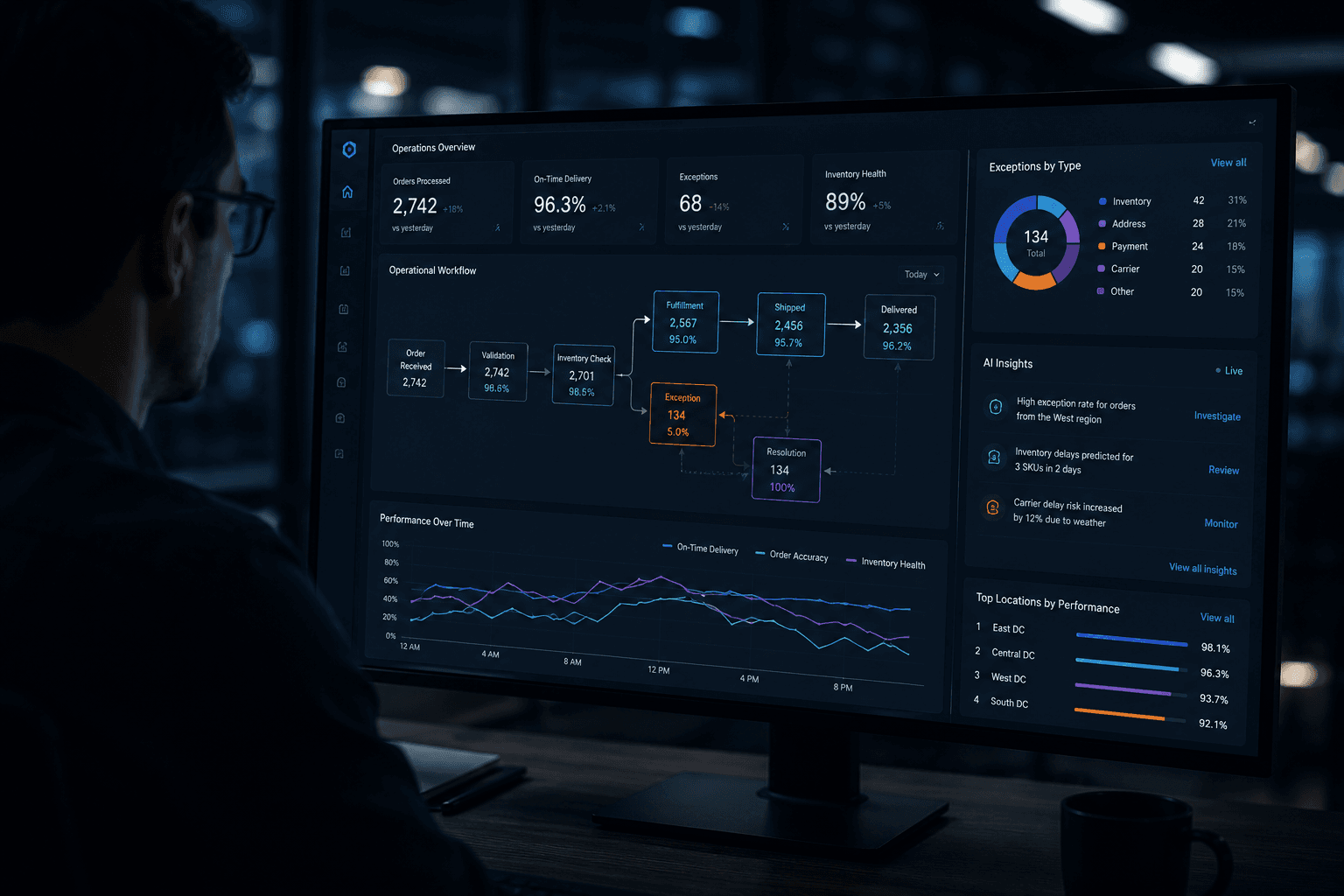
Most organizations approach AI backwards. They start with the technology and work toward a use case. The ones that see real results do the opposite: they start with an operational problem and find the right technology to solve it.
Operational AI isn't about deploying a chatbot or wrapping an LLM around a form. It's about finding where human cognitive effort is being spent on tasks that a well-designed system can do faster, more consistently, and at greater scale.
Where It Actually Lives
The highest-value AI implementations share one trait: they sit in the middle of an existing workflow, not at its edges. They're not bolt-ons. They're embedded in how work actually happens.
Take a compliance team reviewing hundreds of pages of regulatory documents every week. The bottleneck isn't reading. It's cross-referencing, comparing, and surfacing the right clauses for each decision. An AI system that handles the retrieval and synthesis doesn't replace the compliance officer. It gives them three times more time for the judgment that actually matters.
Or picture a customer support team at a software company. Customers submit tickets with complex, configuration-specific questions. The agent has to dig through product docs, previous tickets, and customer settings to write an accurate response. An AI engine with retrieval-augmented generation can surface that context in seconds, turning a 15-minute research task into a 30-second review.
The Three Layers
Every operational AI system we build has three layers.
The Knowledge Layer. This is where structured and unstructured organizational knowledge lives: documents, databases, historical records, product configurations. A good knowledge layer is queryable, current, and scoped appropriately for the use case.
The Orchestration Layer. This is the brain: the models, agents, and logic that decide what to do with a given input. It might call a retrieval system, invoke a tool, apply business rules, or chain multiple models together. This is where most implementations fall short.
The Integration Layer. This connects AI outputs to the systems where work actually happens: CRMs, ERPs, approval workflows, communication channels. Without it, AI stays a prototype that humans have to manually act on.
What Good Looks Like
A mature operational AI implementation runs in production, not just in demos. It has clear human oversight and escalation paths. It improves measurably over time. It integrates with existing systems rather than creating new silos. And it has success metrics tied to business outcomes, not model benchmarks.
The gap between a pilot that impresses a room and a system that drives real operational improvement is almost always implementation quality: the architecture decisions, the retrieval strategy, the integration depth, and how it's maintained over time.
That's what we mean by operational AI.