
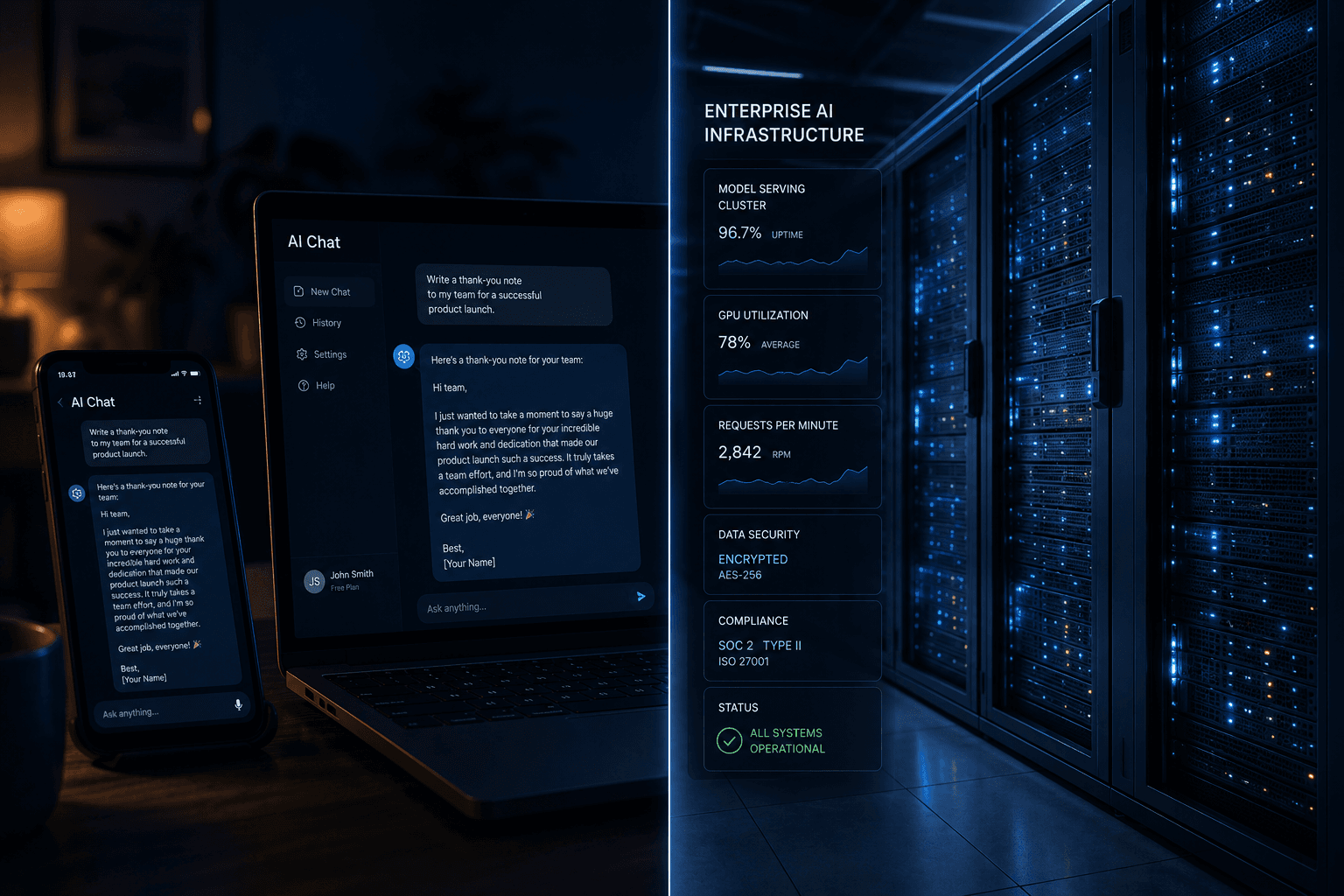
There's a version of this conversation happening in boardrooms right now. A team has been using ChatGPT to draft emails and summarize documents. Results are good. Someone proposes rolling it out more broadly. And then the questions start: What data is it sending to OpenAI? Who has access to what? Can we audit what the AI said last Tuesday? What happens if it's wrong and a customer acts on it?
These are the right questions. And they reveal the fundamental gap between consumer AI tools and enterprise-grade AI systems.
Built for Different Jobs
Consumer AI tools like ChatGPT, Grok, and their equivalents were designed for individual productivity. They're excellent at drafting, brainstorming, summarizing, and researching. The person using them provides the context, reviews the output, and decides what to do with it. The loop is short. The stakes are personal.
Enterprise AI is designed for something different: automating business processes, supporting operational teams, and running inside workflows where the AI is making or informing decisions at volume, across departments, often without a human reviewing every single output.
These are not the same job. Applying consumer tools to enterprise problems is like hiring a talented contractor and expecting them to run a department.
The Four Gaps
Data governance. Consumer AI tools draw on broad public knowledge and whatever you paste into the prompt window. Enterprise AI systems are restricted to approved data sources: your internal systems, your policies, your repositories, your trusted knowledge. The AI sees exactly what you authorize, and nothing more.
System integration. Consumer tools connect to common productivity apps. Enterprise AI integrates directly with your specific platforms: your ERP, your CRM, your document management system, your approval workflows. It doesn't help you copy-paste results from one tool to another. It closes the loop within your existing systems.
Security and data handling. When you use a consumer AI tool, your prompts and the data in them may be used to improve the model, stored on servers you don't control, and potentially visible to the provider's teams. Enterprise AI providers offer contractual zero-retention agreements: your data is processed and discarded. Nothing is retained, and nothing trains the model.
Governance and auditability. Enterprise operations require accountability. If an AI system recommends a vendor, flags a compliance issue, or generates a customer-facing response, you need to know exactly what inputs it received, what it said, who approved it, and when. Consumer tools don't provide this. Enterprise AI systems are built around it: every interaction is logged, every output is traceable, and access is controlled by role.
A Useful Way to Think About It
Consumer AI accelerates individual employees. It makes them faster at specific tasks. That's real value.
Enterprise AI transforms how an organization operates. It changes what workflows are possible, what processes can run at scale, and what your team can focus on. That's a different order of magnitude.
The distinction matters because organizations that try to bridge the gap with consumer tools, by adding policies, browser extensions, or internal guidelines on top of tools that weren't designed for enterprise use, tend to find that the governance and security problems don't actually go away. They just become harder to see.
What Enterprise-Grade Actually Means
A genuine enterprise AI system has a few non-negotiable characteristics.
It runs inside your controlled environment, not outside it. The AI interacts with a carefully scoped subset of your data, not your full systems. Outputs go through validation before they're acted on. Every prompt and response is logged with full auditability. Access is managed through your existing identity and access management (IAM) framework. And the AI provider has contractual obligations around data handling, not just a terms-of-service checkbox.
These aren't features. They're prerequisites for deploying AI responsibly inside an organization that has real operational, regulatory, and reputational stakes.
The Practical Question
The right starting point isn't "which AI tool should we use?" It's "what problem are we solving, who is responsible for the output, and what governance does that require?"
For personal productivity tasks where a human reviews everything, consumer tools are often the right answer. For operational workflows where AI is embedded in business processes, only enterprise-grade systems meet the bar.
Knowing the difference before you deploy saves a significant amount of backtracking later.